Note: VAT rules and thresholds change regularly. This article reflects HMRC rules in force as of September 2026. Always check gov.uk or speak to a qualified accountant before making decisions specific to your business.
1. Know exactly when you must register — and when you shouldn't wait
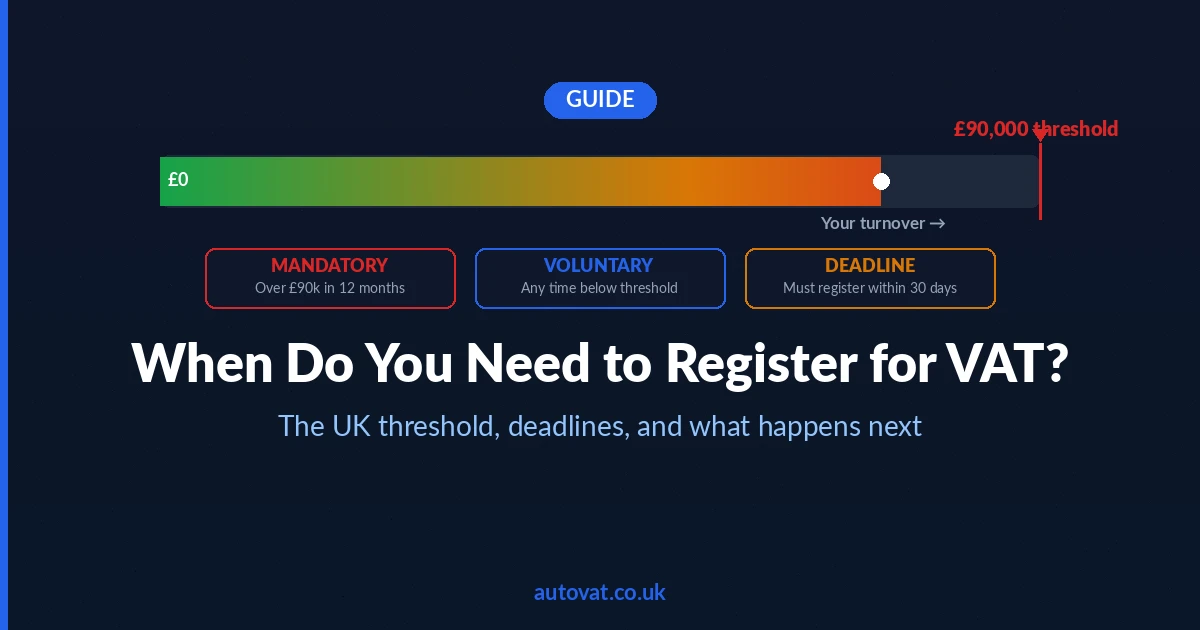
You must register for VAT once your taxable turnover exceeds £90,000 in any rolling 12-month period — not the tax year, not the calendar year, but any 12 consecutive months. Many businesses get caught out because they only check turnover annually; HMRC expects you to monitor it on a rolling basis and register within 30 days of crossing the threshold.
The flip side is just as important: if your turnover is below the threshold, you can still register voluntarily. This makes sense if most of your customers are VAT-registered businesses (they can reclaim the VAT you charge, so it costs them nothing) and you want to reclaim VAT on your own purchases and setup costs. Once registered, you must stay registered until your turnover falls below the £88,000 deregistration threshold — HMRC does not let you flip in and out casually.
2. Choose the VAT scheme that actually fits your business
The standard VAT accounting scheme isn't the only option, and picking the wrong one costs real money. Compare the main schemes before you commit.
| Scheme | Entry threshold | Best for |
|---|---|---|
| Standard VAT accounting | No threshold | Most businesses with reliable cash flow |
| Flat Rate Scheme | £150,000 or less | Low-cost service businesses wanting simplicity |
| Cash Accounting Scheme | £1.35m or less | Businesses with slow-paying customers |
| Annual Accounting Scheme | £1.35m or less | Businesses wanting one return a year, not four |
The Flat Rate Scheme looks appealing because you apply a single sector percentage (ranging from around 4% up to 14.5% of VAT-inclusive turnover) instead of tracking input and output VAT separately — and you get a 1% discount in your first year of registration. But if you're classed as a "limited cost trader" (spending very little on goods), HMRC forces you onto a 16.5% rate instead, which usually makes the scheme worse than standard accounting. Run the numbers both ways before choosing.
The Cash Accounting Scheme means you only pay VAT once your customer has actually paid you, rather than when you invoice — a real cash-flow advantage if you deal with slow payers. Second-hand dealers should also check whether the VAT Margin Scheme applies, since it can dramatically reduce VAT liability on eligible second-hand goods.
3. Treat the penalty points system as a real threat, not a formality
Since HMRC's points-based penalty regime came in, every VAT return filed late earns one penalty point — even if the VAT itself was paid on time. Nothing is charged for the point alone, but once you hit the threshold for your filing frequency (4 points for quarterly filers), HMRC issues a fixed £200 penalty, followed by another £200 for every subsequent late return. There's no cap.
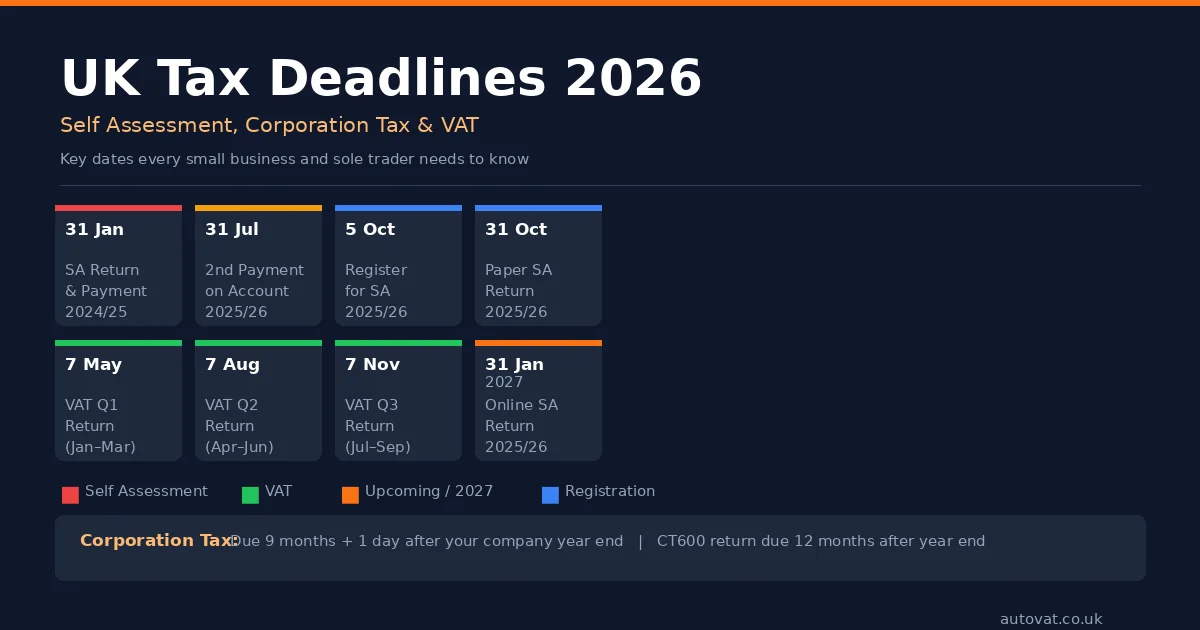
Points expire after two years of compliant filing, but a single late return under pressure can restart the clock. The safest approach is to set filing reminders well ahead of the deadline and never rely on remembering the date from memory — see our guide to UK tax deadlines for a fuller picture of what else is due when.
4. Understand what late payment actually costs
Paying late is more expensive than most business owners assume, and the cost escalates quickly. If you pay in full within 15 days of the due date, there's no late payment penalty. Miss that window and a 3% penalty applies at day 15, a further 3% at day 30, and then a punishing 10% per year accrues daily from day 31 until you pay in full. On top of that, HMRC charges late payment interest — currently 7.75% (Bank of England base rate plus 4%) — from the very first day the payment is overdue, and interest cannot be appealed away; only payment stops it.
If cash flow is genuinely tight, contact HMRC before the deadline to discuss a Time to Pay arrangement. It won't stop interest accruing, but it can prevent the escalating late payment penalties.
5. Don't leave input VAT on the table
Businesses routinely under-claim VAT on legitimate costs simply because they don't keep the right paperwork. You can reclaim VAT on stock, equipment, professional fees, software subscriptions, and most overheads used for your taxable business — but only with a valid VAT invoice. No invoice, no claim, regardless of how obviously business-related the cost was.
Mileage is a common blind spot: if you pay employees a mileage allowance for business travel in their own vehicles, you can reclaim the VAT element on the fuel portion of that allowance using HMRC's advisory fuel rates, provided you keep VAT receipts for fuel covering at least that amount. Many businesses simply don't bother, leaving genuine reclaims unclaimed every quarter.
6. Claim pre-registration VAT on your first return
New registrations frequently miss this one entirely. On your first VAT return, you can reclaim VAT paid before you registered — on goods purchased in the previous 4 years, provided you still hold them (or they've gone into other goods you still hold), and on services purchased in the previous 6 months, provided they relate to your current taxable business. This can mean a meaningful VAT recovery on stock, equipment, and setup costs like legal or accountancy fees incurred before you were VAT-registered. Keep the original invoices — HMRC can and does ask for them.
7. Know which VAT you can never reclaim
Some input VAT is blocked outright, and claiming it anyway is a common inspection finding. Business entertainment — client meals, hospitality, corporate events for customers — is not reclaimable at all, though staff entertainment (like a Christmas party) usually is, subject to conditions. VAT on cars is blocked unless the vehicle is used exclusively for business with no private use whatsoever, which in practice rules out almost every car purchase; commercial vehicles like vans are treated differently and VAT is normally reclaimable. Knowing these blocks in advance avoids an awkward correction later.
8. Use bad debt relief when a customer doesn't pay
If you've paid HMRC output VAT on an invoice your customer never settles, you don't have to just absorb the loss. Once a debt is more than six months overdue (and less than four years and six months old) and you've written it off in your accounting records, you can reclaim the VAT you already paid over to HMRC as bad debt relief. This is under-used because it requires an active step — the relief isn't applied automatically, you have to claim it on your VAT return and keep records proving the debt was written off.
9. Keep digital records — it's the law, not a suggestion
Making Tax Digital (MTD) for VAT is mandatory for all VAT-registered businesses, regardless of turnover. That means keeping digital VAT records and submitting returns through MTD-compatible software with a digital link between your records and your return — copying figures by hand from a spreadsheet into HMRC's portal is not compliant. If you're still using spreadsheets and manual re-entry, or bridging software held together with workarounds, it's worth reviewing your setup properly. See our guide to Making Tax Digital for what compliant record-keeping actually requires.
10. Correct errors the right way — and quickly
Mistakes happen — a missed invoice, a wrong VAT rate, a transposed figure. How you fix it matters. If the net error is under £10,000, or between £10,000 and £50,000 and less than 1% of your turnover for the period, you can simply adjust it on your next VAT return. Larger errors, or ones outside those limits, must be reported to HMRC directly through their online error correction service (the old VAT652 form was withdrawn in September 2025). Correcting errors promptly and voluntarily also matters for penalties — HMRC treats an unprompted disclosure far more leniently than an error it finds itself during an inspection.
11. Get your VAT treatment right at the point of sale, not after
The most expensive VAT mistakes are usually structural, not accidental — charging the wrong rate on a product line, misapplying zero-rating, or getting the VAT liability of a bundled product or service wrong from day one. These errors compound across every sale until someone notices, at which point HMRC will expect the VAT to be found retrospectively out of your own margin, since you usually can't go back and charge customers more after the fact. If you're unsure whether something is standard-rated, reduced-rated, zero-rated, or exempt, check it before you start selling it that way, not after several VAT quarters have passed.
12. Review your VAT setup at least once a year
VAT thresholds, penalty rates, flat rate percentages, and scheme rules change — sometimes annually. A scheme that made sense two years ago may now be costing you money, and a business that's grown past a threshold without noticing can find itself non-compliant overnight. Build a yearly VAT health check into your calendar: confirm you're on the right scheme, check whether your turnover trajectory affects your registration status, and make sure your record-keeping still meets MTD requirements. If you use an accountant, this is exactly the kind of conversation worth having proactively rather than waiting for a VAT inspection to raise it — our guide on what happens during an HMRC VAT inspection covers what inspectors actually look for.
Getting VAT right is mostly about process, not tax knowledge
Almost every VAT tip on this list comes down to the same underlying discipline: keep clean records, know your deadlines, and don't leave reclaims on the table out of inertia. None of it requires deep tax expertise — it requires a system that doesn't rely on someone remembering to do it manually every quarter. For dealers trading under the VAT Margin Scheme specifically, that discipline matters even more, since margin scheme record-keeping has its own strict requirements on top of standard VAT rules.