The VAT registration threshold
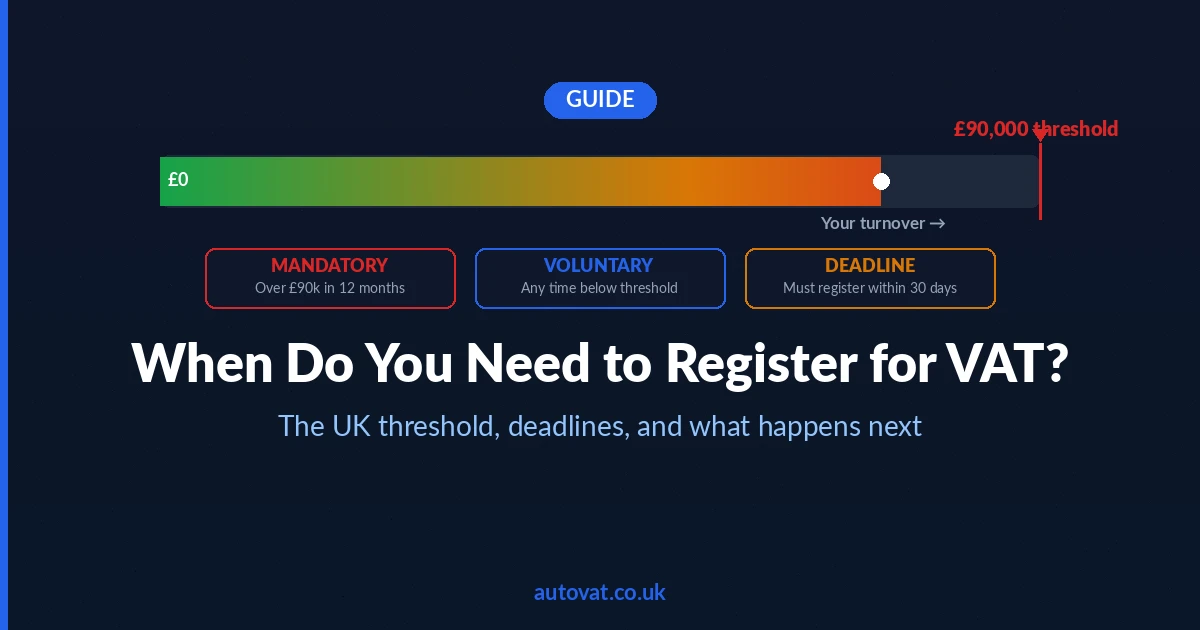
As of April 2024, the VAT registration threshold in the UK is £90,000 of taxable turnover in any rolling 12-month period. This was raised from £85,000 and is currently one of the highest registration thresholds in the world.
If your taxable turnover — the total value of VAT-able goods and services you sell — exceeds £90,000 in any 12-month window, you are legally required to register for VAT. This is not a tax year figure. It is a rolling 12-month figure, which means you need to check it at the end of every month by looking back at the previous 12 months.
For the most up-to-date threshold and official guidance, always refer directly to HMRC: www.gov.uk/register-for-vat.
What counts as taxable turnover?
Taxable turnover includes all sales of goods and services that are subject to VAT at any rate — standard rate (20%), reduced rate (5%), or zero rate (0%). It does not include VAT-exempt sales, such as most financial services, insurance, or residential property lettings.
For dealers using the VAT Margin Scheme, your taxable turnover for registration purposes is calculated on your full selling prices — not just your margins. This is an important distinction. You might be well under the threshold on profit alone, but your gross sales could push you over £90,000.
Example: You buy and sell second-hand cars. In the past 12 months you sold £250,000 worth of cars and made £40,000 in margins. Your taxable turnover for registration purposes is £250,000 — not £40,000. You would have been required to register for VAT long before your margins reached the threshold.
The 30-day rule and when to register
Once your taxable turnover exceeds £90,000 in the previous 12 months, you must register for VAT within 30 days of the end of the month in which you exceeded the threshold. HMRC will then register you from the first day of the second month after you exceeded the threshold.
Example: Your rolling 12-month turnover crosses £90,000 during October 2026. You must apply to register by 30 November 2026. HMRC will register you from 1 December 2026.
There is also a forward-looking test: if you have reasonable grounds to believe your turnover will exceed £90,000 in the next 30 days alone, you must register immediately — before the month ends. This applies when you sign a large contract or win a significant piece of business that will push you over in a short window.
What happens if you register late?
Late registration is treated seriously by HMRC. You will owe VAT from the date you should have registered, not from the date you actually registered. This means you could face a backdated VAT liability on months of sales where you did not charge your customers VAT — a bill you will have to absorb yourself, since you can no longer go back and collect it from customers who already paid.
HMRC also charges a late registration penalty based on how long you were overdue and how much VAT was due. The longer you leave it, the larger the penalty. If you think you may have crossed the threshold in the past and not registered, it is always better to come forward voluntarily than to wait for HMRC to discover the error.
Voluntary registration: registering before you reach the threshold
You can register for VAT at any time, even if your turnover is well below £90,000. There are genuine reasons why some businesses choose to do this.
The main benefit is the ability to reclaim input VAT on your business purchases. If you buy a significant amount of stock, equipment, or services with VAT on them, being VAT-registered lets you recover that tax. For a dealer spending heavily on premises, vehicles, or tools, this can be a meaningful saving.
Voluntary registration can also make your business appear more established to trade customers and suppliers, many of whom prefer dealing with VAT-registered businesses because they can reclaim the VAT on their purchases from you.
The downside is that registration adds administrative obligations — quarterly VAT returns, record-keeping requirements, and the need to charge VAT on your sales. If most of your customers are private individuals who cannot reclaim VAT, adding 20% to your prices can make you less competitive. It is a trade-off that depends on your customer base and buying patterns.
How to register for VAT
VAT registration in the UK is done online through HMRC. The process typically takes around 20 working days and HMRC will confirm your VAT registration number, your effective date of registration, and your first VAT return deadline.
You will need your business details, National Insurance number or company registration number, turnover figures, and bank account details. You can register directly at: www.gov.uk/register-for-vat.
Once registered, you will be added to HMRC's Making Tax Digital (MTD) programme for VAT, which requires you to keep digital VAT records and submit returns using MTD-compatible software.
What changes once you are registered?
From your effective date of registration, you must charge VAT on all taxable sales, issue VAT invoices, keep detailed VAT records, and submit VAT returns — usually quarterly. You can also begin reclaiming input VAT on your business purchases.
For dealers who plan to use the VAT Margin Scheme, VAT registration is the prerequisite. You cannot operate under the Margin Scheme unless you are VAT-registered. Once registered, you can notify HMRC that you intend to use the scheme and begin accounting for VAT on your margins rather than your full selling prices.
VAT registration and the VAT Margin Scheme
Many second-hand dealers — car dealers, antique traders, and online resellers — reach the registration threshold through volume of sales rather than profit. The VAT Margin Scheme is specifically designed to help registered dealers in this position by limiting VAT to the margin on eligible goods rather than the full selling price.
If your gross sales are approaching £90,000, it is worth planning your registration carefully and setting up your Margin Scheme record-keeping from day one. Trying to reconstruct stock records after the fact is one of the most common and costly problems dealers face after a late or rushed registration.
AutoVAT can help you set up compliant Margin Scheme records from your first day as a registered dealer — so you start on the right foot rather than trying to catch up later.