Note: Minimum wage rates are set by the Government and updated each April. This article reflects the rates in force from 1 April 2026. Always verify the current rates at gov.uk or with a qualified employment adviser before making payroll decisions.
The difference between the National Minimum Wage and the National Living Wage
The terms are often used interchangeably, but they refer to different rates. The National Minimum Wage (NMW) is the legal floor for workers aged 16 to 20, as well as apprentices. The National Living Wage (NLW) is the higher rate that applies to workers aged 21 and over — it was introduced in 2016 and has increased faster than the NMW rates in most years since. Both are set by the Government each April following recommendations from the independent Low Pay Commission.
Neither should be confused with the Real Living Wage, which is a voluntary rate calculated separately by the Living Wage Foundation based on actual living costs. The Real Living Wage is higher than the Government's rates and is adopted by accredited employers voluntarily — it has no legal enforcement mechanism.
The April 2026 minimum wage rates
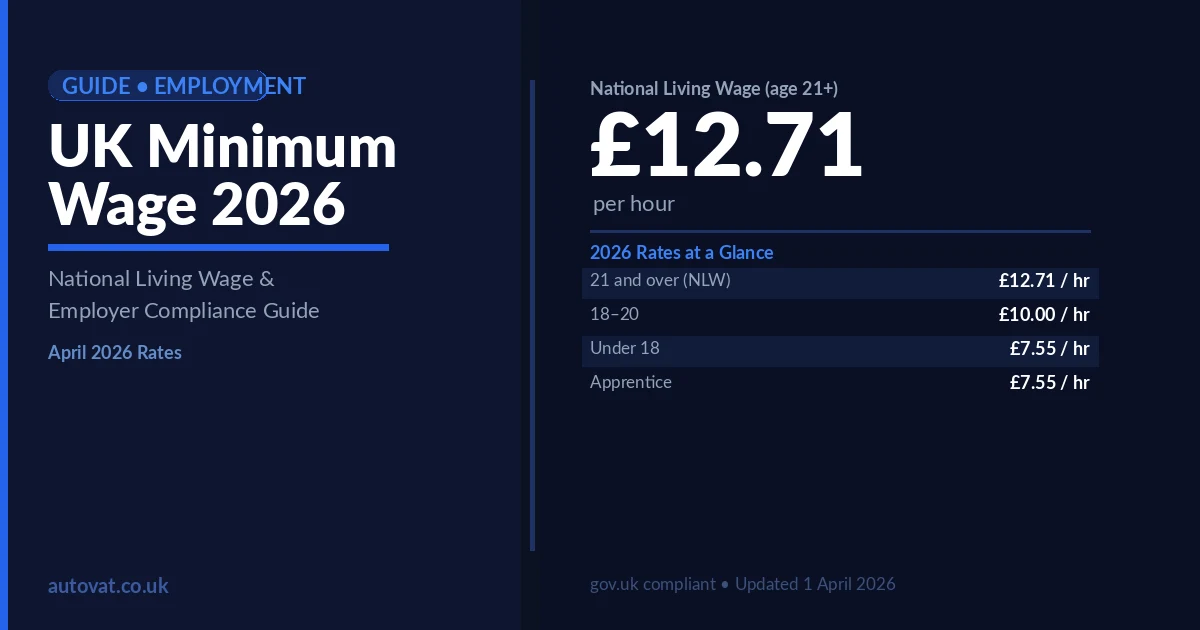
The following rates came into force on 1 April 2026 and apply across England, Scotland, Wales, and Northern Ireland. Unlike some employment rules, minimum wage rates are UK-wide — there is no devolved variation.
| Category | Rate from Apr 2026 | Previous rate | Increase |
|---|---|---|---|
| National Living Wage (aged 21+) | £12.71 | £12.21 | +4.1% |
| 18–20 year olds | £10.85 | £10.00 | +8.5% |
| 16–17 year olds | £8.00 | £7.55 | +6.0% |
| Apprentices | £8.00 | £7.55 | +6.0% |
The 8.5% increase for 18–20 year olds is particularly notable — it is part of a deliberate Government strategy to close the gap between younger workers and those on the National Living Wage, a process that began in earnest in 2024. The Low Pay Commission has indicated that further convergence is likely in future years.
What these rates mean as an annual salary
Hourly rates are useful for payroll, but it helps to see what they translate to across a full working year. Based on a standard 37.5-hour working week over 52 weeks (1,950 hours per year), the annual equivalents are as follows.
A full-time worker aged 21 or over earning the National Living Wage of £12.71 per hour earns approximately £24,784 per year before tax and National Insurance. A worker aged 18–20 on £10.85 per hour earns approximately £21,158 per year. A 16–17 year old or apprentice on £8.00 per hour earns approximately £15,600 per year.
These figures assume the worker works every week of the year with no unpaid leave. In practice, paid holiday entitlement (a minimum of 5.6 weeks for most workers) means the actual number of worked hours is lower, though the minimum wage still applies to all hours worked including during holiday pay calculations.
Who is entitled to the minimum wage
Almost all workers in the UK are entitled to the National Minimum Wage or National Living Wage. This includes part-time workers, agency workers, workers on zero-hours contracts, casual workers, and home workers. It applies regardless of how the worker is paid — hourly, daily, by output, or on a salary — as long as the effective hourly rate does not fall below the minimum.
The rules also apply to overseas workers employed in the UK. There is no exemption for small businesses, new businesses, or businesses that are loss-making. The size of the employer is completely irrelevant — even a sole trader employing a single part-time worker must pay the minimum wage.
Some categories of workers are not covered. Genuinely self-employed people are not entitled to the minimum wage because they are not workers in the legal sense — they set their own rates and bear commercial risk. Company directors are also excluded unless they have a separate employment contract. Volunteers at charities or non-profits who receive only genuine expenses, not remuneration, are also excluded. However, misclassifying employees or workers as self-employed to avoid minimum wage obligations is an increasingly common enforcement target — HMRC takes a very dim view of it.
The apprentice rate explained
The apprentice rate of £8.00 per hour applies only in specific circumstances. It covers apprentices who are either under 19 years old, or aged 19 or over but in the first year of their apprenticeship. Once an apprentice aged 19 or over has completed their first year, they become entitled to the full minimum wage rate for their age group — which for most would be the National Living Wage of £12.71.
This is a common source of underpayment. Employers sometimes continue paying the apprentice rate beyond the point where it is legally permissible. HMRC actively investigates minimum wage compliance in the apprenticeship sector.
What counts as pay for minimum wage purposes
Working out whether a worker is receiving the minimum wage is not always as simple as comparing their hourly rate to the legal minimum. HMRC looks at total remuneration across the pay reference period — typically a week or a month. Certain payments count towards minimum wage pay and others do not.
Payments that count include basic salary, performance bonuses, and commission. Payments that do not count include tips and gratuities paid directly by customers or through a tronc system, premium rates for working bank holidays or overtime (only the base rate of pay counts), advances on wages, loans, and payments that reimburse expenses. This means a worker who relies heavily on customer tips may effectively be earning below the minimum wage on their base pay, and the employer must make up the difference.
Deductions can also affect the calculation. If an employer requires workers to buy a uniform, tools, or other items necessary for the job, and those costs reduce the worker's effective pay below the minimum, that is a breach — even if the deduction is made with the worker's consent.
Penalties for not paying the minimum wage
HMRC enforces minimum wage compliance and takes it seriously. If an employer is found to have underpaid workers, HMRC will issue a Notice of Underpayment requiring the employer to repay the arrears — calculated at the current minimum wage rate, not the rate at the time of the underpayment, which makes historic breaches more expensive to correct. Employers also face a financial penalty of 200% of the arrears owed, up to a maximum of £20,000 per worker.
In addition to the financial penalties, persistent or deliberate non-compliance can result in public naming on the HMRC minimum wage naming scheme — a list published by the Department for Business and Trade that names employers who have underpaid workers. Being named on the list carries reputational consequences that go beyond the financial penalties, particularly for consumer-facing businesses.
Workers who believe they are being underpaid can report it to HMRC via the Pay and Work Rights helpline or online at gov.uk. They can also bring an employment tribunal claim for unlawful deduction from wages. There is no qualifying period for bringing such a claim — a worker can bring it from day one of employment.
The Real Living Wage — a separate voluntary standard
The Real Living Wage, set by the Living Wage Foundation, is calculated based on the actual cost of living in the UK rather than economic targets. For 2025/26, the Real Living Wage is £12.60 per hour across the UK and £13.85 per hour in London, reflecting the higher cost of living in the capital. These rates happen to be close to the Government's National Living Wage this year, but the two are calculated differently and diverge in some years.
Around 15,000 employers have voluntarily accredited as Real Living Wage employers. Accreditation signals a commitment to paying employees enough to live on, not merely enough to satisfy the legal minimum. For some businesses, particularly those competing for talent in tight labour markets, accreditation provides a meaningful recruitment and retention advantage.
What small business employers need to do now
If you employ staff and have not yet updated payroll for the April 2026 rates, you need to do so immediately — the rates have been in force since 1 April and any underpayment since that date is already a breach. Update your payroll software, check that any salaried workers' effective hourly rates still exceed the minimum when divided by their contracted hours, and review any apprenticeship arrangements to make sure the right rate is being applied at the right stage.
It is also worth reviewing your employment contracts. A contract that specifies a fixed hourly rate below the new minimum is unenforceable in that respect — the statutory rate overrides the contractual term — but it creates administrative and legal risk and should be updated. If you use a payroll bureau or accountant, confirm that they have applied the April 2026 uprating to all eligible workers.
For businesses that use casual or zero-hours workers, the same rules apply. The minimum wage applies to every hour worked, and casual status does not reduce the obligation. Pay slips must be issued to all workers and must show the total pay and deductions for each pay period, which makes any underpayment straightforward for HMRC to identify on inspection.
Looking ahead
The Low Pay Commission has been asked to recommend 2027 rates that are broadly consistent with the Government's aim of keeping the National Living Wage at around two-thirds of median UK earnings. Based on current forecasts, further increases are expected in April 2027, though the exact amounts will depend on wage growth and inflation data in the intervening months. Employers should build upward flexibility into their pay structures rather than treating the minimum as a fixed ceiling.
The long-term trend is clear: minimum wages in the UK have risen substantially faster than general inflation over the past decade, and the Government has shown no inclination to reverse that direction. Businesses that structure their labour costs around the minimum wage should plan for continued annual increases as a baseline assumption.