Note: This article is for informational purposes only and does not constitute legal or financial advice. Always verify current fees and requirements directly with Companies House or your chosen formation agent before proceeding.
Why incorporate as a limited company?
Sole traders can operate without forming a company, but many business owners eventually choose to incorporate as a private limited company (Ltd). The main reasons are limited liability — the company's debts are separate from your personal finances — and the perception of credibility, which matters when dealing with larger suppliers, lenders, and trade customers. Some VAT Margin Scheme dealers also find that incorporating helps them separate business and personal finances more cleanly, which simplifies VAT record-keeping and year-end accounts.
Once incorporated, your company is a separate legal entity registered at Companies House. It has its own company number, its own bank account, and its own tax obligations — including Corporation Tax on profits.
What you need before you register
Before you can register a limited company, you need to have a few things ready. First, a company name that is not already taken — you can check availability on the Companies House name availability checker. Second, a registered office address in the UK (this is publicly listed on the Companies House register, so many people use a registered address service rather than their home address). Third, at least one director who is over 16 years old, and details of any shareholders and their shareholdings. Finally, a Standard Industrial Classification (SIC) code describing what the business does — there is a full list on the Companies House website.
If you have all of this ready, the actual registration process is quick — often completed in under 24 hours online.
Registering directly with Companies House
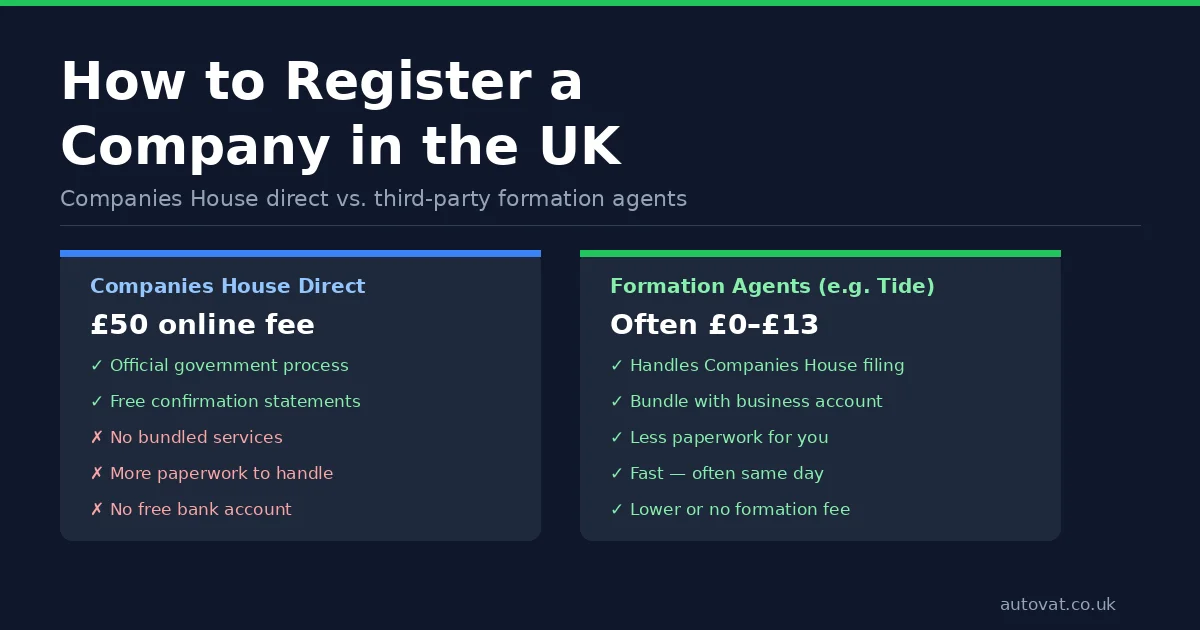
The official route is to register directly through Companies House at gov.uk/limited-company-formation. The online fee is £50 and registration is usually processed within 24 hours. You complete the IN01 form online, provide your details, and Companies House will issue your Certificate of Incorporation and company number once approved.
This is the official, government-run process. There are no hidden fees, no upsells, and everything is done directly with the registrar. You are in full control and the process is straightforward if you are comfortable navigating government websites.
The downsides are that you get only the incorporation — nothing else. You then need to separately open a business bank account, set up your accounting software, register for Corporation Tax with HMRC, and handle all the other administrative steps yourself. That additional admin, while not difficult, takes time if you are setting up for the first time.
Using a third-party formation agent
Formation agents are companies that handle the Companies House registration on your behalf and often bundle other services alongside it. Well-known options include Tide, Formations Factory, 1st Formations, and Companies Made Simple, among others.
The main appeal is cost and convenience. Several formation agents offer company registration for £0 to £13 — significantly cheaper than the £50 Companies House fee — because they subsidise the formation cost in exchange for your business banking or other services. Tide, for example, offers company formation bundled with opening a Tide business current account. You fill in your details once, and you end up with both a registered company and a business bank account in one go, often in a single working day.
Other agents offer registered office address services, nominee director services, VAT registration assistance, or annual confirmation statement reminders — services that can save time if you are not familiar with what a company needs to stay compliant after incorporation.
What third-party agents actually do differently
It is important to understand that formation agents are still registering your company with Companies House — there is no alternative registry or shortcut. The actual legal registration happens at Companies House regardless of whether you go direct or use an agent. The agent acts as an intermediary: they collect your information, submit the application to Companies House on your behalf, and pass the results back to you.
What they add is a smoother user experience, often a cleaner interface than the Companies House online system, and the ability to bundle additional services. They do not give you any different type of company or any advantage in the eyes of the law — the resulting limited company is identical whether you registered directly or through an agent.
Which option is right for you?
If you are comfortable with online government forms and want to keep things as simple and direct as possible, going straight to Companies House is perfectly fine. You pay £50, get your company number, and handle the rest yourself. There is no intermediary involved and no risk of being upsold services you do not need.
If you want a faster, smoother experience — particularly if you plan to open a Tide business account anyway — using a formation agent like Tide makes practical sense. You effectively get the company registration cheaper or free, and your bank account set up at the same time. For someone starting from scratch with no existing bank account, this combination can save a meaningful amount of both money and time.
If you have more complex requirements — a registered address service, multiple share classes, a bespoke Articles of Association, or nominee services — specialist formation agents like Formations Factory or 1st Formations offer packages that cover these at competitive prices.
What happens after you register?
Once your company is registered, there are several things you need to do promptly. You must register for Corporation Tax with HMRC within three months of starting to trade — you can do this at gov.uk/register-for-corporation-tax. You need to open a business bank account if you have not already (a limited company cannot use a personal bank account for business funds). You should set up your accounting records from day one, since limited companies must file annual accounts and a confirmation statement with Companies House each year.
If your turnover will exceed the VAT threshold (currently £90,000 in any rolling 12-month period), you will also need to register for VAT. For dealers who plan to use the VAT Margin Scheme, VAT registration is a prerequisite — and setting up your stock book and margin scheme records from the very first sale will save considerable effort later.
Annual obligations of a limited company
Running a limited company comes with ongoing compliance obligations that sole traders do not have. Every year you must file a confirmation statement with Companies House (currently a £34 online fee), file annual accounts with Companies House, and file a Corporation Tax return with HMRC along with paying any Corporation Tax due. If you have employees, PAYE obligations apply. Staying on top of these deadlines matters — late filing triggers automatic penalties.
Most small companies use an accountant to handle their year-end accounts and Corporation Tax return, which typically costs £500–£1,500 per year depending on the complexity of the business.
The practical bottom line
For most people starting a new limited company, the choice is straightforward. If you want the cheapest and most direct option, Companies House online at £50 is entirely adequate. If you want to save money on formation and get your business bank account set up at the same time with minimal paperwork, Tide's combined formation and account package is hard to beat. Either way, the resulting company is the same — what differs is the experience of getting there and what ancillary services you end up with.
Once your company is registered and your bank account is open, make sure you set up your VAT and accounting infrastructure before you start trading. The cleaner your records from day one, the simpler your first year-end will be.