Note: This guide covers the general process for starting a business in the UK as of September 2026. Rules vary by industry and business type, so check gov.uk or speak to an accountant or solicitor for advice specific to your situation.
1. Decide on your business structure
Before you can register anything, you need to know what you're registering. The three common structures in the UK are:
- Sole trader — simplest to set up, you keep all profits after tax, but you're personally liable for business debts. Good for testing an idea with low risk.
- Limited company — a separate legal entity from you. Your personal liability is limited to what you've invested, profits are more tax-efficient above a certain level, but there's more admin: annual accounts, a confirmation statement, and Companies House filings every year.
- Partnership — two or more people share responsibility, profits, and liability. Rarely the right choice unless you're going into business with someone else from day one.
Most people who plan to trade seriously — buying stock, hiring staff, or taking on business risk — choose a limited company for the liability protection, even though it means more ongoing paperwork. If you're trading second-hand goods (cars, electronics, antiques) under the VAT Margin Scheme, the structure you choose doesn't change your eligibility for the scheme, but it does affect how you register for VAT later.
2. Choose and check your business name
Your business name needs to work in at least three places at once: Companies House, your domain registrar, and (ideally) the Intellectual Property Office trademark register. Check all three before you fall in love with a name.
- Companies House name check — search the Companies House register to confirm the exact name isn't already taken. Names that are "too similar" to an existing company can also be rejected, so leave some distance from close matches.
- Domain availability — check whether the matching .co.uk and .com are free before committing. A name that's available at Companies House but only available as a domain with numbers or hyphens tacked on is a weaker long-term choice.
- Trademark search — search the UK trademark register to make sure you're not stepping on an existing registered brand. This matters even if the company name is free — trademark infringement is a separate legal risk from company name duplication.
If the name isn't a perfect match everywhere, decide early which platform you'll compromise on. Most businesses prioritise the domain and trademark being clean over having the exact literal string as the company name, since customers interact with your brand, not your Companies House filing.
3. Register your company with Companies House
If you're forming a limited company, registration ("incorporation") is done online at gov.uk and typically costs £50 for same-day online registration, or you can use a formation agent for a similar or slightly higher fee if you want extra support. You'll need:
- A company name and registered office address (this becomes public record)
- At least one director and details of any people with significant control (PSC) — usually shareholders owning more than 25%
- A SIC code describing what your business does
- Articles of association — the standard "model articles" are fine for most small companies
Sole traders don't register with Companies House at all — instead, you register with HMRC directly (see step 6), which is quicker but doesn't create the same liability separation.
4. Buy your domain and set up business email
Once your name is confirmed, register the domain immediately — even before your website is built — so nobody else can take it while you're still setting up. Buy the .co.uk and .com if both are relevant to your market, and consider grabbing obvious misspellings or the .org if you have budget for it.
Set up email on your own domain (e.g. [email protected]) rather than using a free Gmail or Outlook address for business correspondence. It's cheap, takes minutes with most domain registrars or Google Workspace/Microsoft 365, and it materially affects how customers and suppliers perceive you — a generic free-tier email address is one of the fastest ways to look unregistered or untrustworthy to a B2B buyer.
5. Open a business bank account
Limited companies are legally required to keep business finances separate from personal ones, since the company is its own legal entity. Sole traders aren't legally required to have a separate account, but it's strongly recommended — mixing personal and business transactions makes bookkeeping, tax returns, and any future VAT registration far harder to get right.
Most banks (both high-street and challenger banks like Starling, Tide, or Monzo Business) require your Companies House registration number and proof of ID/address for directors before opening an account, so this naturally follows step 3 rather than preceding it.
6. Register with HMRC for the right taxes
This is where sole traders and limited companies diverge most:
- Sole traders register for Self Assessment with HMRC, which also registers you for Class 2/4 National Insurance. This must be done by 5 October in your business's second tax year, though registering as soon as you start trading avoids any risk of missing the deadline.
- Limited companies are automatically registered for Corporation Tax when incorporated through Companies House (if you tick the option), or you can register separately within 3 months of starting to trade. You'll also need to file a Company Tax Return each year, separate from any personal Self Assessment for directors.
If you plan to hire anyone, you'll also need to register as an employer for PAYE before your first payday, so HMRC can process income tax and National Insurance deductions from wages.
7. Register for VAT — mandatory or voluntary
VAT registration is often the step new business owners think about last, but it deserves early attention because it changes your pricing, invoicing, and record-keeping from day one.
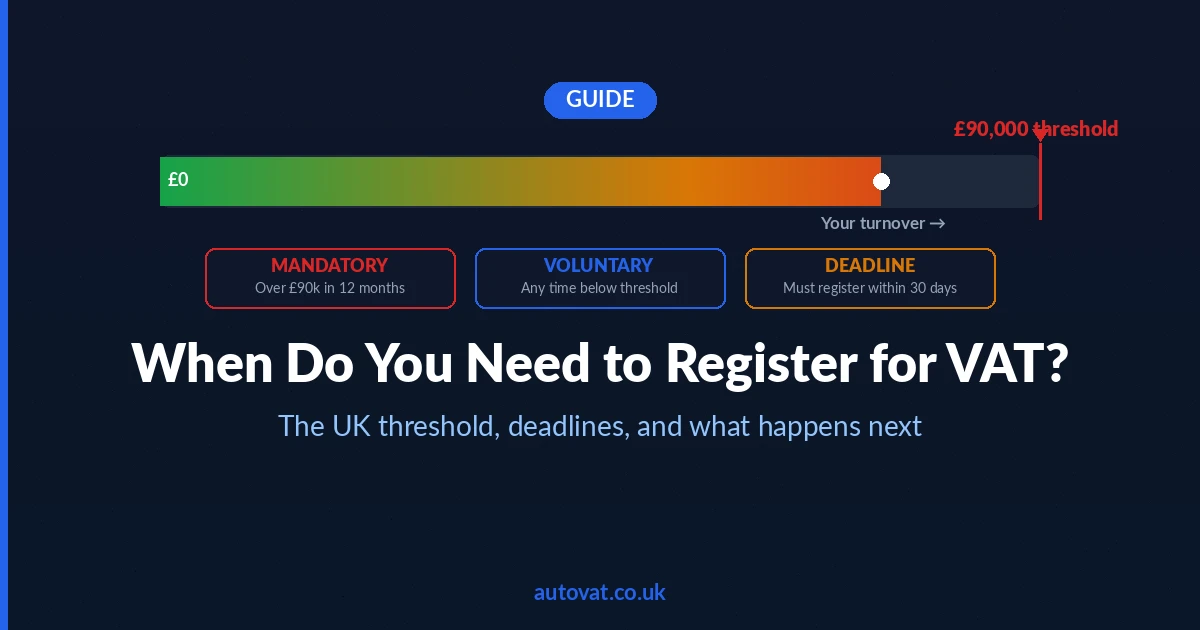
You must register once your taxable turnover exceeds £90,000 in any rolling 12-month period — not the tax year, any 12 consecutive months — and you have 30 days from crossing the threshold to register. Our guide on when to register for VAT covers this in detail, including what counts as taxable turnover.
You can also register voluntarily before you hit the threshold, which makes sense if:
- Most of your customers are VAT-registered businesses who can reclaim the VAT you charge, so it costs them nothing
- You want to reclaim VAT on setup costs, stock, and equipment purchased in your first months of trading
- You want to look more established to suppliers and business customers, since a VAT number signals a certain scale
If you're going into second-hand goods — cars, electronics, jewellery, antiques — check whether the VAT Margin Scheme applies to your stock before you register under standard VAT rules. Under the margin scheme you pay VAT only on your profit margin rather than the full selling price, which can significantly reduce your VAT bill, but it comes with its own strict record-keeping requirements (the "stock book") that need to be built into your process from your very first sale, not retrofitted later.
Whichever route you take, Making Tax Digital (MTD) for VAT is mandatory once you're VAT-registered, regardless of turnover — you'll need MTD-compatible software with a digital link between your records and your VAT return from day one.
8. Sort out licences, insurance, and industry-specific registrations
Depending on what you sell, you may need more than the standard registrations above:
- Trading licences — some goods and activities (used cars, scrap metal, waste, food, alcohol) require specific local authority or environmental licences before you can legally trade.
- Business insurance — public liability is close to essential if customers ever visit your premises or handle your goods; employer's liability insurance is a legal requirement the moment you hire staff.
- Data protection registration — if you hold customer personal data (most businesses with a website and customer list do), you likely need to register with the ICO and pay the annual data protection fee.
9. Build your record-keeping system before you make your first sale
The single most common mistake new businesses make isn't a missed registration — it's starting to trade with no proper bookkeeping system, then trying to reconstruct records months later for a VAT return or tax filing. Set up your accounting software, invoicing template, and (if applicable) VAT Margin Scheme stock book before your first transaction, not after your first VAT quarter closes. It's far easier to maintain clean records from day one than to rebuild them retrospectively under deadline pressure.
The order, summarised
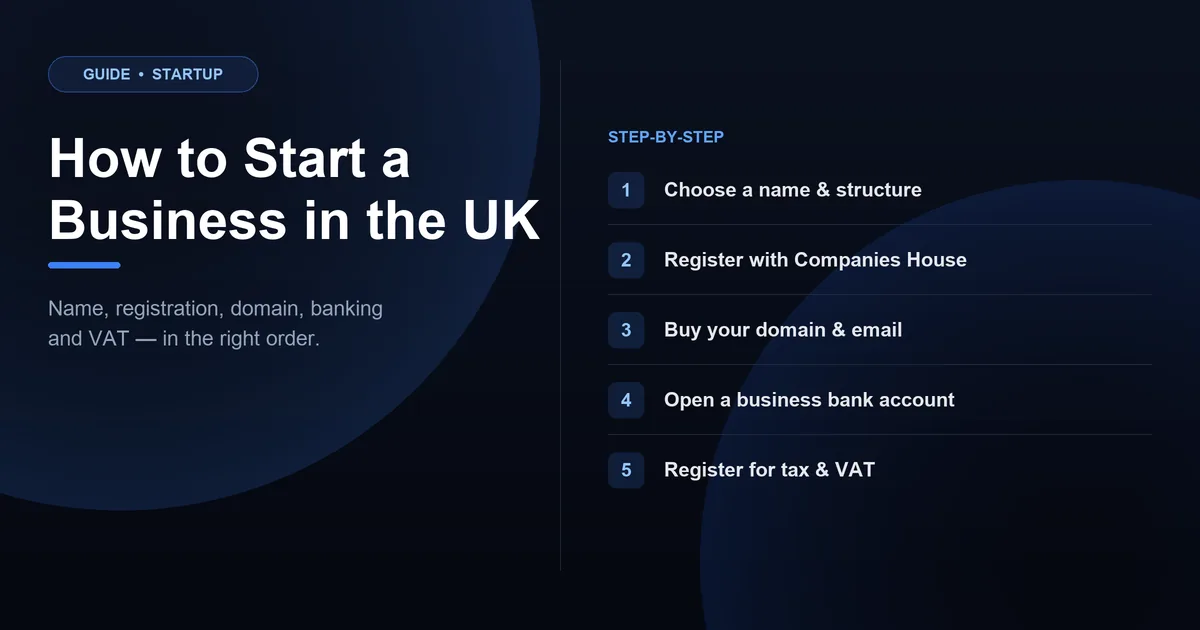
Roughly: decide your structure, check your name is free everywhere it needs to be, register with Companies House (or HMRC directly if sole trader), buy your domain and set up email, open a business bank account, register for the right HMRC taxes, register for VAT (mandatory or voluntary), sort any industry-specific licences and insurance, and get your record-keeping running before you trade. Doing these out of order is rarely fatal, but it usually means backtracking — registering a domain after a competitor takes it, or discovering three months in that you should have registered for VAT voluntarily from the start.