Note: This article is for informational purposes only. AutoVAT is not a financial adviser. Always check the latest terms, fees, and eligibility directly with each bank before opening an account.
Why you need a separate business bank account
Mixing personal and business money is one of the most common mistakes made by new business owners and sole traders. Even if you are a sole trader and legally not required to have a separate account, keeping business income and expenses in a dedicated account makes everything easier — tax returns, VAT calculations, expense tracking, and showing HMRC a clean audit trail if you are ever investigated.
For limited companies, a separate business account is effectively required — you cannot legally mix a company's money with your personal funds, since a limited company is a separate legal entity from you as an individual.
For dealers using the VAT Margin Scheme in particular, a clean business account makes it far easier to reconcile purchases and sales, spot discrepancies, and produce the records HMRC expects.
What to look for in a business bank account
Not all business accounts are equal. The features that matter most for small businesses and dealers are monthly fees (many accounts are free or very low cost), the ability to integrate with accounting software like Xero or QuickBooks, the quality of the mobile app, ease of making and receiving payments, cash deposit facilities if you deal in physical cash, and the quality of customer support.
For VAT-registered businesses, an account that exports transaction data in a format compatible with your bookkeeping software saves significant time at quarter end. The fewer manual steps between your bank and your VAT return, the better.
Digital challenger banks — fast, free, and app-first
Starling Bank is widely regarded as one of the best free business current accounts in the UK. There are no monthly fees for the basic business account, the app is excellent, and it integrates directly with Xero, QuickBooks, and FreeAgent. You can pay in cash at Post Offices, which matters for dealers who receive cash payments. Starling is fully FCA-regulated and FSCS-protected up to £85,000.
Monzo Business offers a free tier with solid basic features and a paid Pro tier (around £9/month) that adds accounting integrations, tax pots, and invoice creation. The app is clean and well-designed. Monzo is also FSCS-protected. The free tier lacks direct accounting software integration, which can be a limitation for VAT-registered businesses.
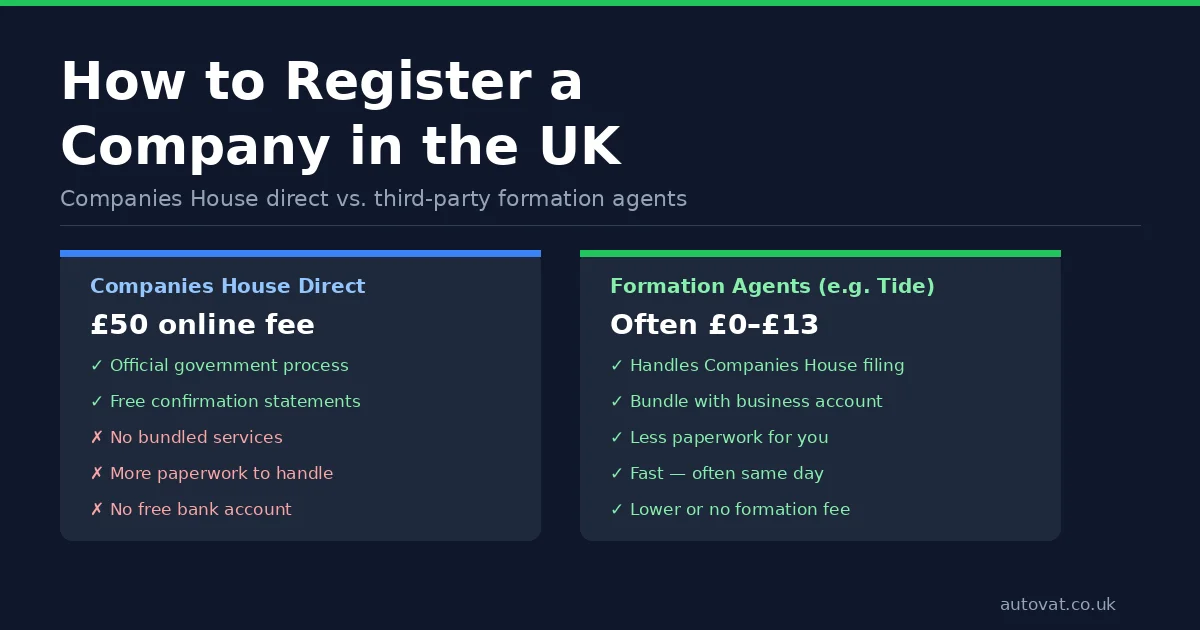
Tide is popular with sole traders and small limited companies. It offers a free account with low transaction fees and a paid Plus tier. Tide also offers company formation services — you can register a new limited company through Tide at a lower cost than going directly, and your business account is set up at the same time. This makes it a convenient one-stop option if you are starting from scratch.
Traditional high street banks
Barclays, HSBC, Lloyds, NatWest and other high street banks all offer business current accounts. These typically come with a free introductory period (often 12–24 months) before monthly fees of £6–£12 kick in. The advantages are physical branches, relationship managers for more complex needs, and established lending products if you ever need a business loan or overdraft. The disadvantages are slower onboarding, more paperwork, and apps that often lag behind the challengers in usability.
If you regularly deal in large cash volumes, pay in frequently at a branch, or anticipate needing a business overdraft or loan in the near future, a traditional bank relationship is worth having. Many businesses run both — a free digital account for day-to-day payments and a traditional account for access to credit.
Accounts worth considering for dealers specifically
For second-hand dealers, car traders, and market sellers, the practical requirements are slightly different from a typical service business. You may receive payments in cash, via bank transfer, via online platforms like PayPal or eBay, and sometimes via card terminals. You need an account that handles all of these cleanly.
Starling's Post Office cash deposit facility and strong Xero integration make it a practical choice for dealers who want a free account with serious functionality. Tide suits those who want a very quick setup, especially if registering a company at the same time. Traditional banks suit those who need physical branches and lending products.
Separating your VAT funds
One habit that separates well-run businesses from chaotic ones is setting aside VAT as you go. Every time money comes in, a portion of it belongs to HMRC — it is not yours to spend. Some accounts (Monzo Pro, for example) offer "pots" or savings pockets where you can automatically set aside a percentage of income for VAT. This prevents the common and painful experience of reaching quarter end with a VAT bill you cannot afford to pay.
Even without a built-in pot feature, you can achieve the same thing manually by transferring the VAT portion of each payment into a dedicated savings account the same day it arrives. For VAT Margin Scheme dealers, the amount to set aside is one sixth of your margin on each item sold.
The bottom line
For most small businesses and sole traders starting out, a free digital account — Starling in particular — offers everything needed with no monthly cost and excellent accounting integrations. If you are forming a new limited company and want a streamlined setup process, Tide's combined company formation and account opening is worth looking at. If you need physical banking, lending products, or handle very large cash volumes, supplement a digital account with a traditional bank relationship.
Whatever account you choose, set it up before you start trading, keep it strictly for business use, and integrate it with your bookkeeping software from day one. The cleaner your financial records, the easier your VAT returns — and the more time you spend on your actual business.