The short answer: your customer pays VAT, always
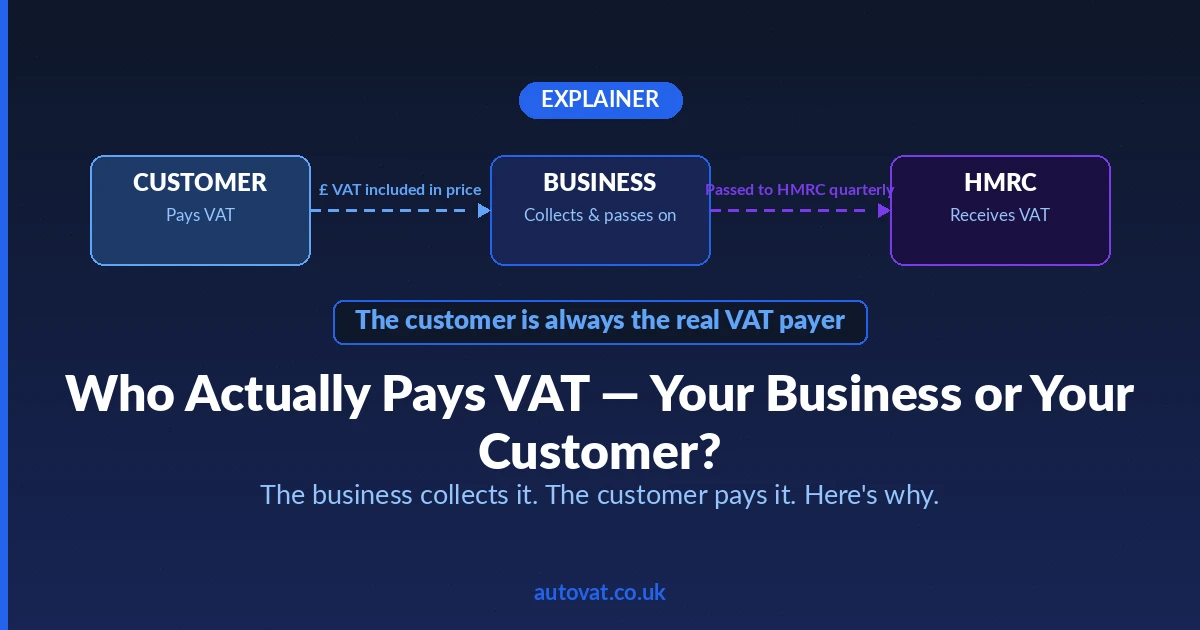
VAT stands for Value Added Tax, and it is a tax on consumption — on spending. Every time a customer buys something that has VAT applied to it, they are paying that tax as part of the price. The 20% (or 5%, or other rate) is not a cost to your business. It is a cost to whoever is buying from you.
Your business acts as a middleman. You collect the VAT from your customer at the point of sale, hold it temporarily, and then pass it on to HMRC at the end of each VAT quarter. You are not out of pocket. You never were. The money was the customer's from the moment they handed it over.
A simple example to make it concrete
You sell a second-hand item for £120 under standard VAT. Of that £120, £100 is your sale price and £20 is VAT at 20%.
Your customer hands over £120. You keep £100 as your revenue and set aside £20. At the end of the quarter you send that £20 to HMRC. Your business is no poorer than if VAT did not exist — you still received your £100. The customer, however, paid £20 more than they would have without VAT.
The VAT came entirely out of the customer's pocket. Your business was simply the collection mechanism.
So why does the business collect it rather than the customer paying HMRC directly?
This is the part that most people never stop to think about — but it is actually a very deliberate and sensible design decision.
Consider what would happen if every customer had to pay their VAT directly to HMRC themselves. After buying a car, a sofa, a meal, a pair of shoes — they would need to calculate how much VAT was in each purchase, keep records of every transaction, and file a return with HMRC. For the average person, that is completely impractical. Most people could not do it accurately, and even if they could, the cost of hiring an accountant to manage it would be far more than the VAT itself.
Businesses, on the other hand, already have the infrastructure to handle this. They keep records of their sales as part of running their business. They have accounting systems or accountants or bookkeepers. They are already producing invoices, tracking income, and filing returns with HMRC for other purposes. Adding VAT collection to that process is far less burdensome for a business than it would be for tens of millions of individual consumers.
So HMRC made a practical choice: put the administration on the business, not the customer. The customer just pays a price that includes VAT built in. The business handles all the paperwork, the record-keeping, and the quarterly payment. It is more efficient, more reliable, and far easier to enforce.
The business as a tax collector, not a taxpayer
This framing matters. When you collect VAT from your customers and pay it to HMRC, you are acting as an unpaid tax collector on behalf of the government — not as a taxpayer yourself. The VAT your customers pay does not belong to your business. It was never yours. You are holding it in trust until the payment is due.
This is why treating VAT money as part of your business cash flow is a dangerous habit. Dealers who spend the VAT they have collected before the quarter end can find themselves with a serious cash flow problem when the HMRC bill arrives. It is not your money to spend — it belongs to the customer who already paid it, and ultimately to HMRC.
What about the VAT Margin Scheme — does this still apply?
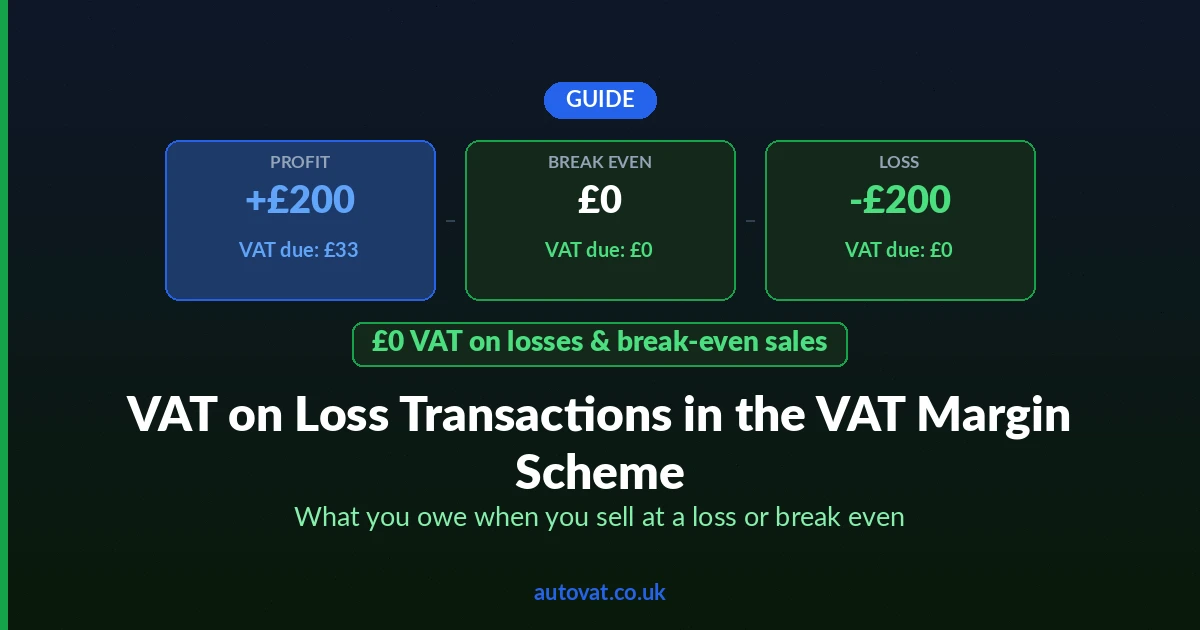
Yes, the same principle holds. Under the VAT Margin Scheme, you only charge VAT on your profit margin rather than the full selling price. But that VAT is still embedded in the price your customer pays. If you sell a car for £10,000 and your margin is £2,000, the £333 VAT due (£2,000 ÷ 6) is part of what the buyer paid for the car. Your business passes it to HMRC. The buyer bore the cost.
The Margin Scheme reduces how much VAT ends up in the price — which benefits the buyer, makes your pricing more competitive, and reduces the amount you collect and pass on. But it does not change who ultimately funds the tax.
Input VAT: the one exception where a business does benefit
There is one part of the VAT system where businesses genuinely do get money back: input VAT. When a VAT-registered business buys goods or services for its own business use and pays VAT on them, it can reclaim that VAT from HMRC. This is input VAT recovery, and it means the business is not taxed on its own costs — only on the value it adds.
Note that under the VAT Margin Scheme, you cannot reclaim input VAT on the purchase price of margin scheme stock — that is one of the trade-offs of using the scheme. But you can still reclaim input VAT on your general business overheads: rent, software, professional fees, utilities, and so on.
The bottom line
VAT is a tax on the end consumer. Businesses collect it, administer it, and remit it — but they do not bear its cost. The system is designed this way because it is far more practical to have businesses manage the collection than to ask every individual customer to file their own VAT returns. Your business is doing HMRC a favour by handling the administration. The VAT itself always comes from whoever is buying from you.