The core rule: no margin, no VAT
The VAT Margin Scheme is built on a simple principle — you only pay VAT on the profit you make. The formula is always: selling price minus purchase price = margin, and VAT is calculated at one sixth of that margin.
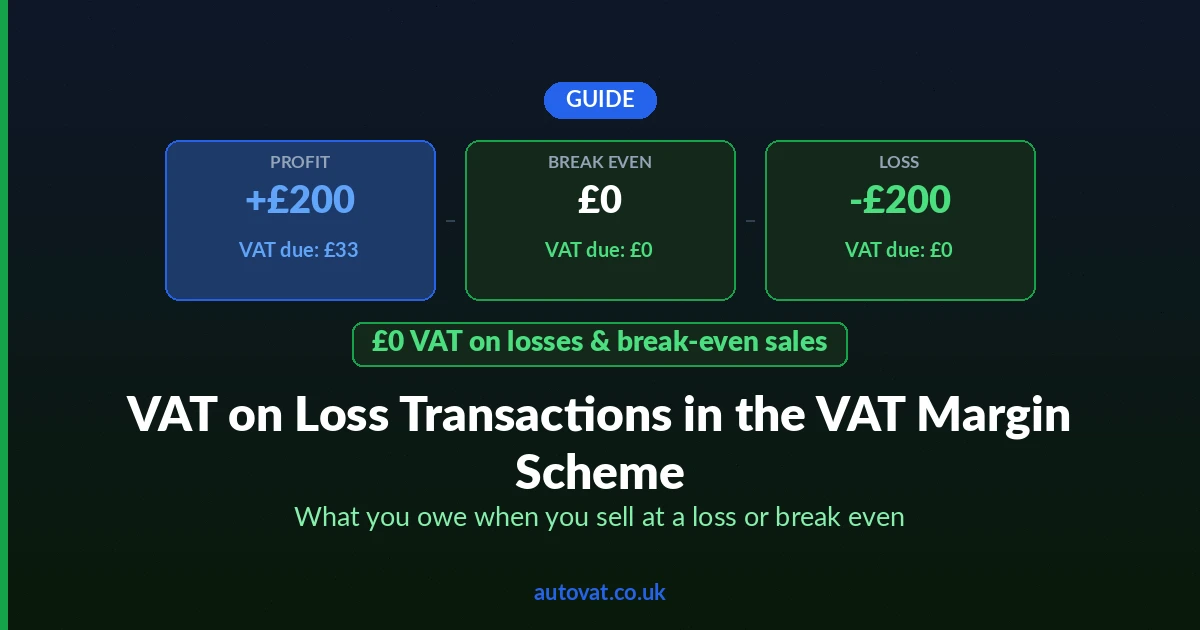
This means that if your margin is zero or negative, your VAT liability on that item is also zero. HMRC does not charge VAT on a loss — there is no minimum VAT floor, and you do not pay VAT on the full selling price just because a margin cannot be calculated. The scheme genuinely protects dealers from paying VAT on transactions where no profit was made.
Selling at a loss: a worked example
You buy a second-hand car for £8,000 and, after it sits unsold for three months, you sell it for £6,500. Your margin is negative £1,500.
VAT due on this transaction: £0.
You do not owe HMRC anything on this sale. You have absorbed a £1,500 loss and there is no VAT consequence — other than how that loss is treated in your accounting method, which we cover below.
The zero-profit (break-even) scenario
You buy a piece of furniture for £400 at auction and sell it for exactly £400. Your margin is £0.
VAT due: £0.
A zero margin produces zero VAT. This might seem obvious, but it matters in practice — some dealers worry that selling at cost triggers some minimum VAT charge. It does not. The Margin Scheme is clear: VAT is only due where there is a positive margin.
How losses are treated under individual accounting
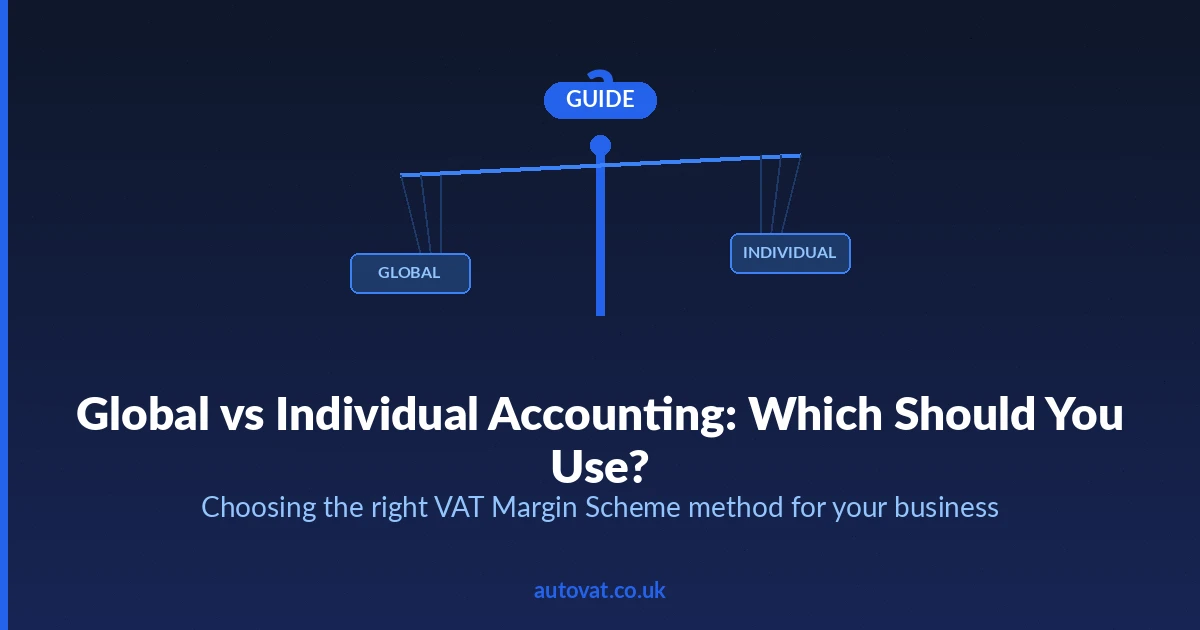
Under individual accounting, each item is calculated separately. A loss on one item cannot offset the profit on another item. The loss simply produces a zero VAT liability for that transaction, and that is the end of it — the negative margin is not carried anywhere or used to reduce the VAT on your other profitable sales in the same period.
Example: In one quarter you sell two items:
- Item A: bought £1,000, sold £1,600 — margin £600, VAT due £100
- Item B: bought £2,000, sold £1,400 — margin −£600, VAT due £0
Total VAT due for the quarter: £100. The £600 loss on Item B does not cancel out the £600 profit on Item A under individual accounting. You still owe £100 in VAT.
How losses are treated under global accounting
Under global accounting, all your eligible purchases and sales in the period are pooled together. Losses do offset profits because you calculate one combined margin across all stock sold in the quarter.
Using the same two items as above under global accounting:
- Total selling prices: £1,600 + £1,400 = £3,000
- Total purchase prices: £1,000 + £2,000 = £3,000
- Global margin: £0
- VAT due: £0
The loss on Item B fully offsets the profit on Item A, resulting in zero VAT for the quarter. This is one of the key advantages of global accounting for dealers with mixed stock performance — though it comes with its own restrictions (notably, it cannot be used for motor vehicles or items with a purchase price over £500).
What happens to a negative global margin?
If your global margin for an entire quarter is negative — your total losses exceeded your total profits — no VAT is due for that period, and the negative margin is carried forward to the next quarter. It effectively gives you a head start on offsetting future profits.
Example: Quarter 1 global margin is −£2,000. No VAT due. In Quarter 2 your global margin is +£5,000. You deduct the carried-forward −£2,000, giving a net margin of £3,000. VAT due = £3,000 ÷ 6 = £500, rather than £5,000 ÷ 6 = £833.
This carry-forward only applies to global accounting. Under individual accounting there is nothing to carry forward — the loss simply closes out at zero for that item.
Common misconception: repair costs and the margin
Some dealers try to factor in repair and restoration costs to push their margin into negative territory and eliminate VAT. HMRC does not allow this. Only the original purchase price of the item can be used as the cost in the margin calculation. Money spent on cleaning, repairing, or improving the item is not deductible from the selling price for Margin Scheme purposes.
If you spent £500 buying a chair and £300 restoring it, your purchase price for the margin calculation is still £500 — not £800. If you sell it for £700, your margin is £200 and VAT is £33.33, not zero.
Do you still need to record loss transactions?
Yes — even though no VAT is due, HMRC requires every eligible item to have a stock book entry, including those sold at a loss or at cost. The record must show the purchase price, selling price, margin (even if zero or negative), and VAT due (£0). Missing records, even for loss transactions, can put your ability to use the scheme at risk during an HMRC inspection.
How AutoVAT handles losses automatically
AutoVAT calculates the correct VAT position for every transaction — including losses and break-even sales — and records them properly in your stock book. Under individual accounting, loss transactions are closed at zero. Under global accounting, negative margins are automatically carried forward to the next period. At the end of each quarter, your return figures reflect the correct position with no manual calculations needed.