What actually happens in a part-exchange deal
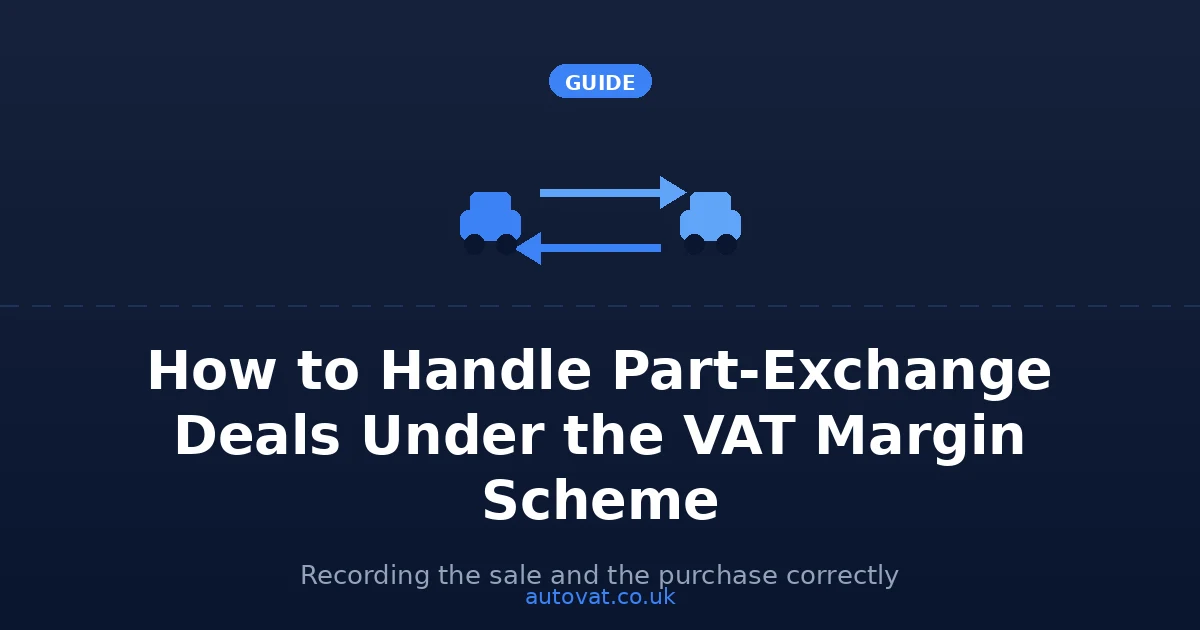
When a customer part-exchanges a vehicle (or any other item), two distinct transactions occur simultaneously. First, you are selling a stock item to the customer. Second, the customer is selling their part-exchange item to you. These are separate transactions for VAT purposes, and you need to record them that way in your books — even though only a single net payment changes hands.
The sale side of the deal
The item you are selling to the customer is treated exactly like any other margin scheme sale. Record the selling price — which is the agreed retail value of the item you are selling, not the top-up cash payment — and calculate the margin against what you originally paid for that stock. The fact that the customer is not paying you entirely in cash does not change how the sale is recorded for VAT purposes.
For example, if you sell a car with an agreed price of £8,000 and the customer part-exchanges their vehicle at an agreed value of £3,000, the sale price of your car is £8,000. The customer then pays you £5,000 in cash to make up the difference. Your margin is calculated on £8,000 minus what you originally paid for the car you are selling.
The purchase side of the deal
The vehicle or item you take in part-exchange becomes a new purchase in your stock book. The purchase price is the agreed part-exchange value — £3,000 in the example above. You need to record:
- Description of the item taken in part-exchange (make, model, year, condition, VIN or serial number where applicable)
- The date of acquisition
- The agreed part-exchange value (this is your purchase price)
- The name and address of the customer who traded it in
The part-exchange item is then eligible for the margin scheme when you sell it on, provided it came from a private individual or a non-VAT-registered business. This is the most common scenario — a private customer trading in their own vehicle.
When the part-exchange is not eligible
If the customer is a VAT-registered business and they have reclaimed input VAT on the vehicle they are trading in, it cannot enter your margin scheme stock. You would need to account for it under standard VAT rules when you come to sell it. Always check at the point of taking in the part-exchange whether the customer is VAT-registered and whether they have claimed input VAT on the item.
No VAT invoice should be issued
When you take in a part-exchange from a private individual, there is no VAT invoice to issue or receive. The purchase is simply recorded in your stock book at the agreed value. Issuing a VAT invoice for the part-exchange value would incorrectly suggest that VAT has been charged — which it has not — and could complicate your records.
Worked example
You sell Car A (which you bought for £5,000) to a private customer at an agreed price of £9,000. The customer trades in Car B at an agreed part-exchange value of £4,000 and pays you £5,000 cash.
- Sale of Car A: selling price £9,000, purchase price £5,000, margin £4,000, VAT due = £4,000 × 1/6 = £666.67
- Purchase of Car B: recorded into stock at £4,000, eligible for the margin scheme on its next sale
Both transactions are recorded separately in your stock book. The £5,000 cash payment is simply the net settlement — it does not appear as either the sale price or the purchase price in your margin scheme records. For full guidance on part-exchange VAT treatment, see HMRC's VAT margin schemes guidance.
How AutoVAT handles part-exchanges
AutoVAT splits part-exchange deals into their two component transactions automatically — a sale record and a new stock purchase — so your stock book stays accurate and HMRC-ready without you having to think through the accounting each time. Get in touch to see how we configure this for your business.