What is individual accounting?
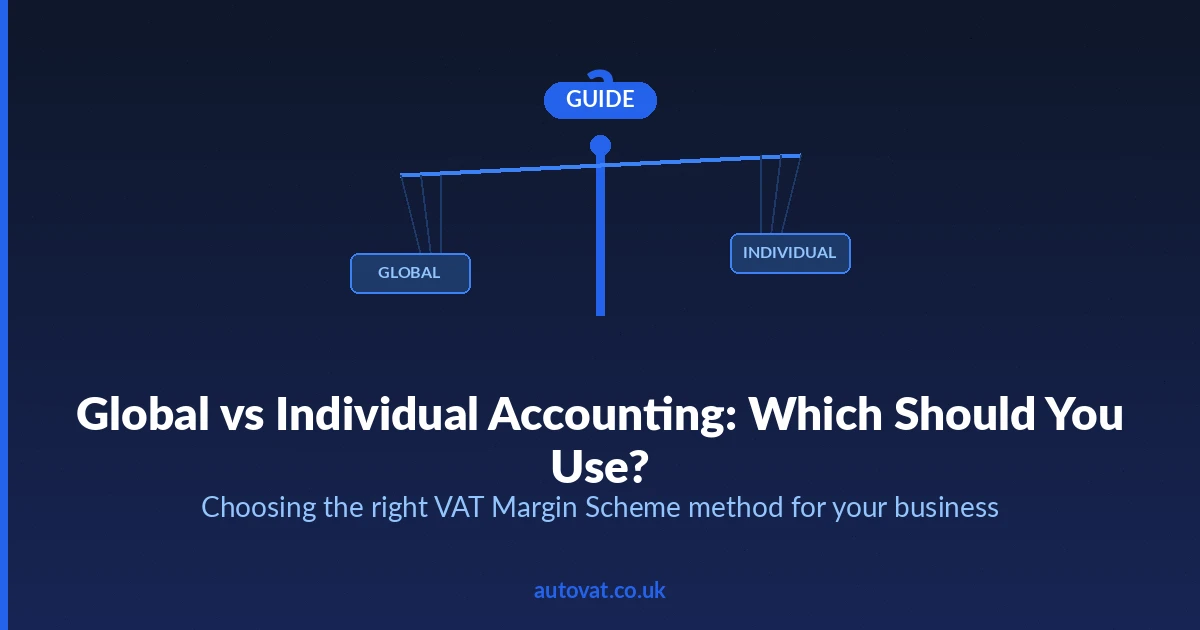
Individual accounting is the default method under the VAT Margin Scheme. Under this approach, you calculate the margin and VAT due on each item separately when it is sold. If an item sells for more than you paid, VAT is due on the margin. If it sells for less than you paid — a loss — no VAT is due on that item, but the loss cannot be used to reduce the VAT on other profitable sales in the same period.
Individual accounting is straightforward in principle and works well for businesses selling high-value items where each transaction is clearly distinct — car dealers, jewellers, and fine art dealers typically use this method. It gives you a precise VAT position on every item and is generally preferred by HMRC as it is easier to audit.
What is global accounting?
Global accounting is a simplified alternative that allows you to pool all eligible purchases and sales across an entire VAT period rather than tracking each item individually. Instead of calculating a margin per item, you calculate one overall margin for the period:
Global margin = Total selling prices in the period − Total purchase prices in the period − Opening stock value + Closing stock value
VAT is then calculated at one sixth of the global margin. If the global margin is negative (your total purchases exceeded your total sales for the period), no VAT is due and the negative margin is carried forward to the next period.
The key advantage of global accounting
The main benefit is that losses on individual items automatically offset profits on others within the same period. If you buy a job lot, sell half of it profitably and the rest at a loss, the losses reduce your overall VAT liability in a way that individual accounting does not permit.
This makes global accounting particularly attractive for dealers who buy in bulk — market traders, online resellers buying mixed pallets, and second-hand goods dealers sourcing stock from clearance sales. The simplified calculation also reduces the administrative burden of maintaining a detailed per-item stock book.
The restrictions on global accounting
Global accounting is not available for all goods. Notably, it cannot be used for motor vehicles, aircraft, vessels, horses, or ponies. Car dealers must use individual accounting. Global accounting also cannot be used for any item where the purchase price exceeded £500 — those items must be accounted for individually even if the rest of your stock uses global accounting.
There is also a risk that global accounting can mask a worsening VAT position. If your closing stock value is consistently rising, you may be deferring VAT rather than eliminating it, and a sharp drop in stock value in a later period could produce a large unexpected VAT bill.
Can you switch between methods?
Yes — you can switch from individual to global accounting, or vice versa, but you must notify HMRC in writing and cannot switch back within 12 months. Before switching, it is worth modelling the VAT impact across a full trading year, because the switch date can significantly affect which period's VAT return absorbs your opening stock position.
Which method is right for your business?
Individual accounting suits dealers selling distinct, identifiable items with clear purchase records — cars, antiques, jewellery, and art. The per-item approach gives maximum precision and is the cleanest method for HMRC compliance purposes.
Global accounting suits high-volume dealers with lower-value mixed stock, where tracking every item individually would be impractical. Market traders, vintage clothing dealers, and mixed second-hand goods sellers often benefit from the pooled approach.
If you are unsure which method applies to your stock or whether you are eligible for global accounting, AutoVAT reviews your business before configuration and recommends the right approach — then sets up your records accordingly.
How AutoVAT handles both methods
AutoVAT supports both individual and global accounting. We configure your system at the outset to match your trading pattern, and if your business evolves — for example, you expand from cars into mixed collectibles — we can adjust your setup and walk you through a compliant method switch. Your VAT position is always clear, and your quarterly return figures are prepared automatically whichever method you use. You can also use our free VAT Margin Scheme Calculator to compare individual transaction margins before committing to a method.